Listening as an experiment, eavesdropping as a process
Lux + Kahlil reflect on their performance, EAVESDROP, at the fair’s 13th edition in February 2026
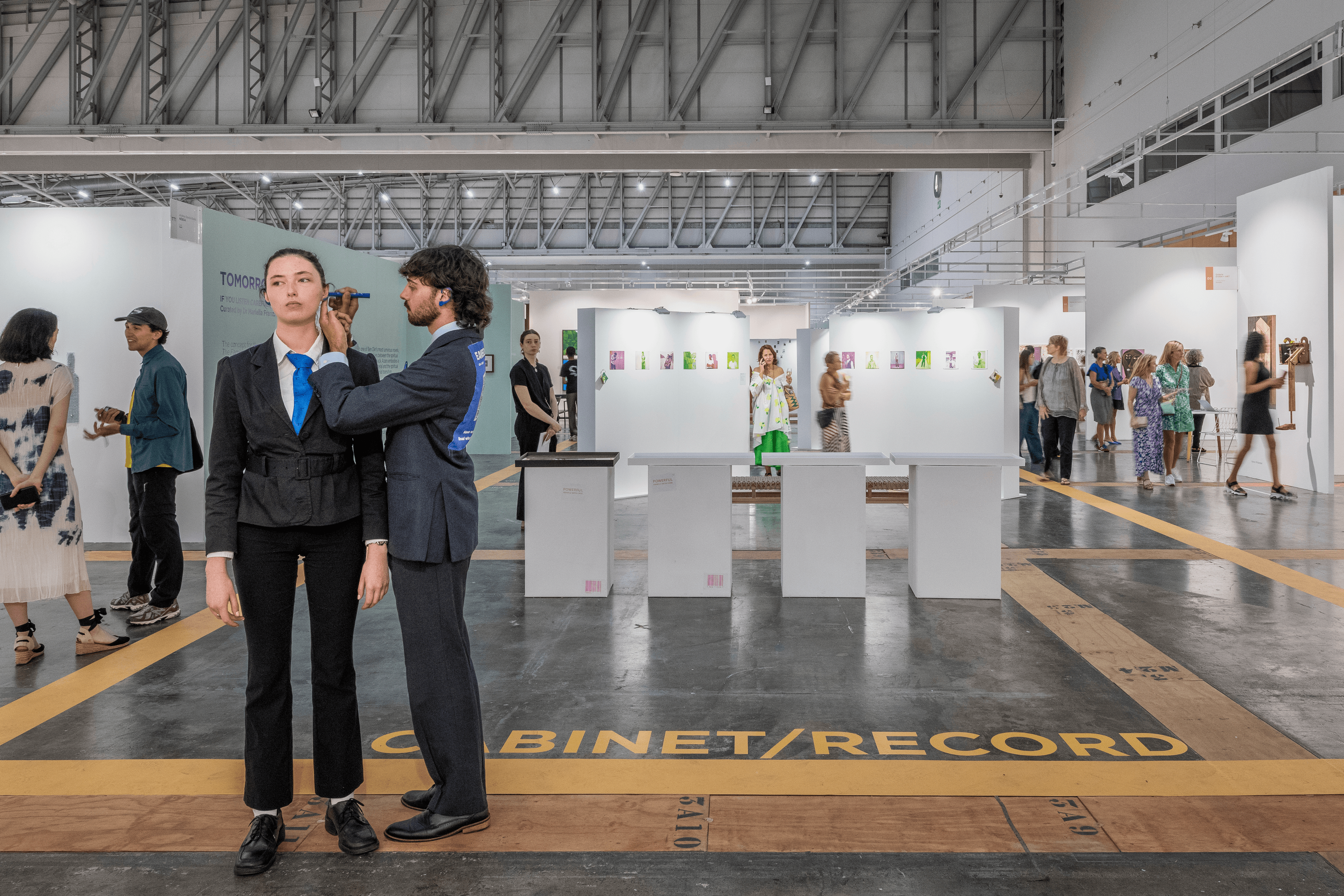
“We wanted to stand out and completely fit in”, says Kahlil Visser, on EAVESDROP.
Over the course of our recent 13th edition of Investec Cape Town Art Fair, you may have noticed two people in suits, moving slowly through the fair with intention, their ears adorned with a distinctly blue paint. This was Lux + Kahlil’s performance, EAVESDROP, which took place throughout the fair weekend. We sat down with the two performers behind the group, Leah Mascher (Lux) and Kahlil Visser, who shared their reflections on their experimental performance in listening and observing, in addition to considered approaches to moving through space.
Cover Image: Photograph by Anthea Pokroy
Listening is an important facet in a longer process of communication. When we listen, there are times when we are mainly receiving information (or a sound, a type of input) in a rather one-sided exercise. However, most of the time, listening is a key piece of a broader, active engagement that accompanies moments of feedback, processing, and, if necessary, a response. Debuting at our 13th edition as a special project, Performance brought a variety of remarkable performance artists and their practices into the fair space, which was fittingly guided by the edition's curatorial concept, Listen. And in a sense, the introduction of Performance felt like a conversation: a dialogue between embodied, acted performance art, and the more still, object-based art on gallery walls. Each occupying important corners of the contemporary art world, the presence of so many artistic mediums encouraged discourses founded on many layers, and with this, a textured terrain of voices and perspectives.
Taking place as an ongoing performance throughout each day of Investec Cape Town Art Fair 2026, Lux + Kahlil’s EAVESDROP was an experiment in testing the boundaries, processes and questions informing a type of listening. The performance’s namesake draws its origin from what eavesdropping generally entails: ‘to listen in without permission, to overhear, and to snoop’. The 2026 fair was the largest edition to date, and such a space witnesses a profound number of conversations, meetings, catch-ups, and opinions being shared simultaneously and over time. Further, the fair is a point of exchange across so many cultures, personalities, artistic viewpoints and political stances. Lux + Kahlil wished to engage with this social matrix: curious to witness these numerous moments of connection, while acting as impartial observers, catching fragments of conversation that came their way.
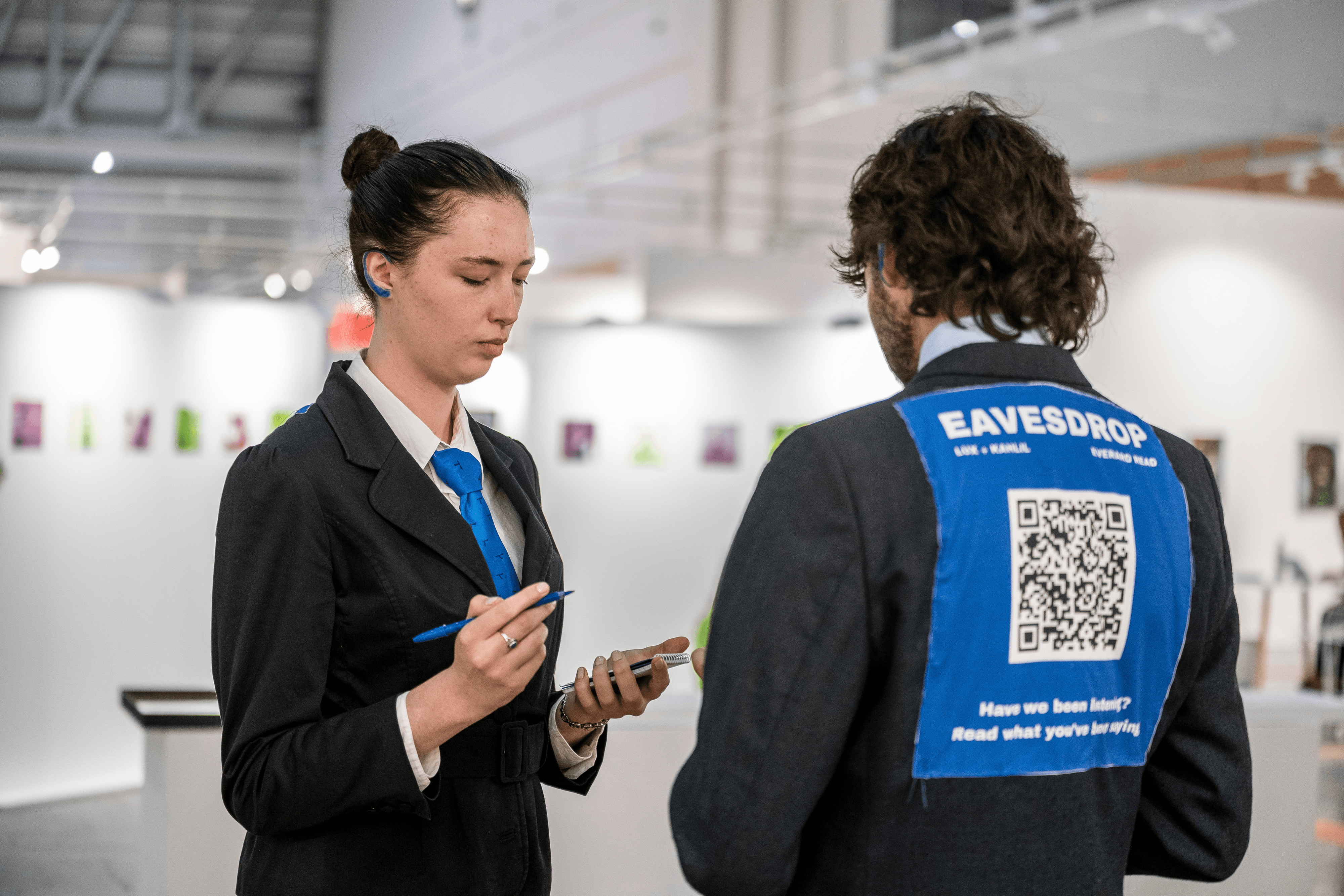
Lux + Kahlil compare notes of what they each heard while walking through Investec Cape Town Art Fair. Photograph by Anthea Pokroy.
The nature of the performance being ongoing as opposed to being a fixed performance at one time and location ensured that EAVESDROP remained as much an experiment as a performance. While there were certain rules guiding how they conducted their eavesdropping, there was also time and flexibility to adapt according to what the environment needed once they had begun.
Reflecting on this, Lux noted: “The art fair is busy. The art fair is loud. It’s constantly moving. Even the art changes constantly. So I was thinking, ‘should it be a performance where we have a located space?’, there’s pros and cons to that… and then I was thinking performance is physical, should it be omnipresent? Let’s move around…”. Further, she went on to explain how a moving and constantly evolving performance could also be informed by a guiding structure: “I need time to process. So I liked constructing boundaries like, ‘Okay, I’m not going to speak to anyone. I’m only going to move around… Constructing boundaries, having rules, and then embracing whatever the body responds to: like its failures. So our rules were: don’t speak to people, only listen. Listening is a bodily function: I can do that, I don’t have to be creative about that. And embracing the failure: I don’t have to hear everything.”
The performance itself followed a general procedure. The fair’s weekend saw ten hours of listening by the pair. Each day, from Friday 20 February to Sunday 22 February 2026, Lux + Kahlil eavesdropped in three shifts. This included an hour of walking around, listening and writing down what was heard in a notebook, followed by an hour to transcribe and post anonymous snippets onto Everard Read’s Instagram page, then an hour of rest. “From the banal to the brilliant”, the performance documented almost every overheard piece of conversation that drifted past the two eavesdroppers.
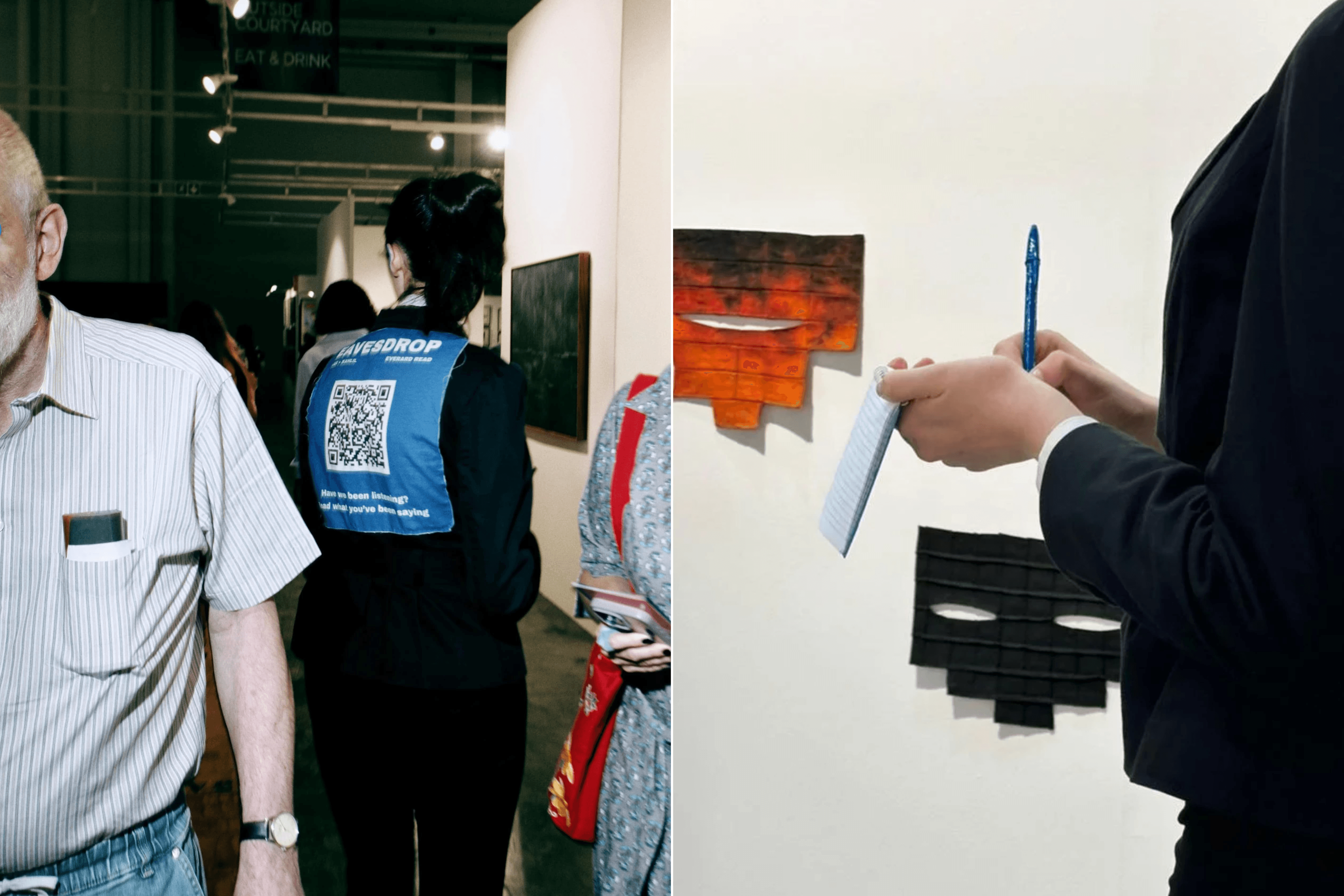
LEFT: Lux drifts through a group of fair visitors. Photograph by Kwei Shun-Yu. Courtesy of Lux + Kahlil. RIGHT: Recording what was heard. Photograph by Theo Wesselink. Courtesy of Lux + Kahlil.
Each shift began with a meditative process to get into character. Kahlil reflected on the importance of this process to get into a type of character: “Theatre comes with a circus of attention… you’ve got to get into a meditative way. So the way that we brought that into our performance, and what became the performance, was when it was time for us to start eavesdropping, we’d walk out in our suits. We’d found the centre space in Cabinet/Record, close to the entrance. We’d find somewhere to stand, and then we’d stand there across from each other, in a neutral position, looking at each other, then looking around, and taking that moment to settle ourselves. It gains attention as well, which is what we want… And then, when we were ready, when we felt like we had alkalined or neutralised ourselves, we looked at each other, gave each other a little nod, we checked our watch because it was time based, and then we’d begin the process of painting the ears blue one by one… not just done with care, but also finding the rhythm and the pace, slowing ourselves down, even more in our actions. Then we added an extra thing of neatening each other…”
Lux spoke more on this: “When you’re getting into a scene, there’s a process you have to follow, like getting into costume, and then tuning in… there is a meditative aspect in acting. You have to get into a zone where you can focus and where you can receive things, and exchange, and have some kind of clarity. So that is what we both understood. Kahlil is very talented: they have this amazing ability to think on their feet and to be creative - physically and with words - and that’s why I asked Kahlil to be part of my team… I can trust this energy to work with me.”
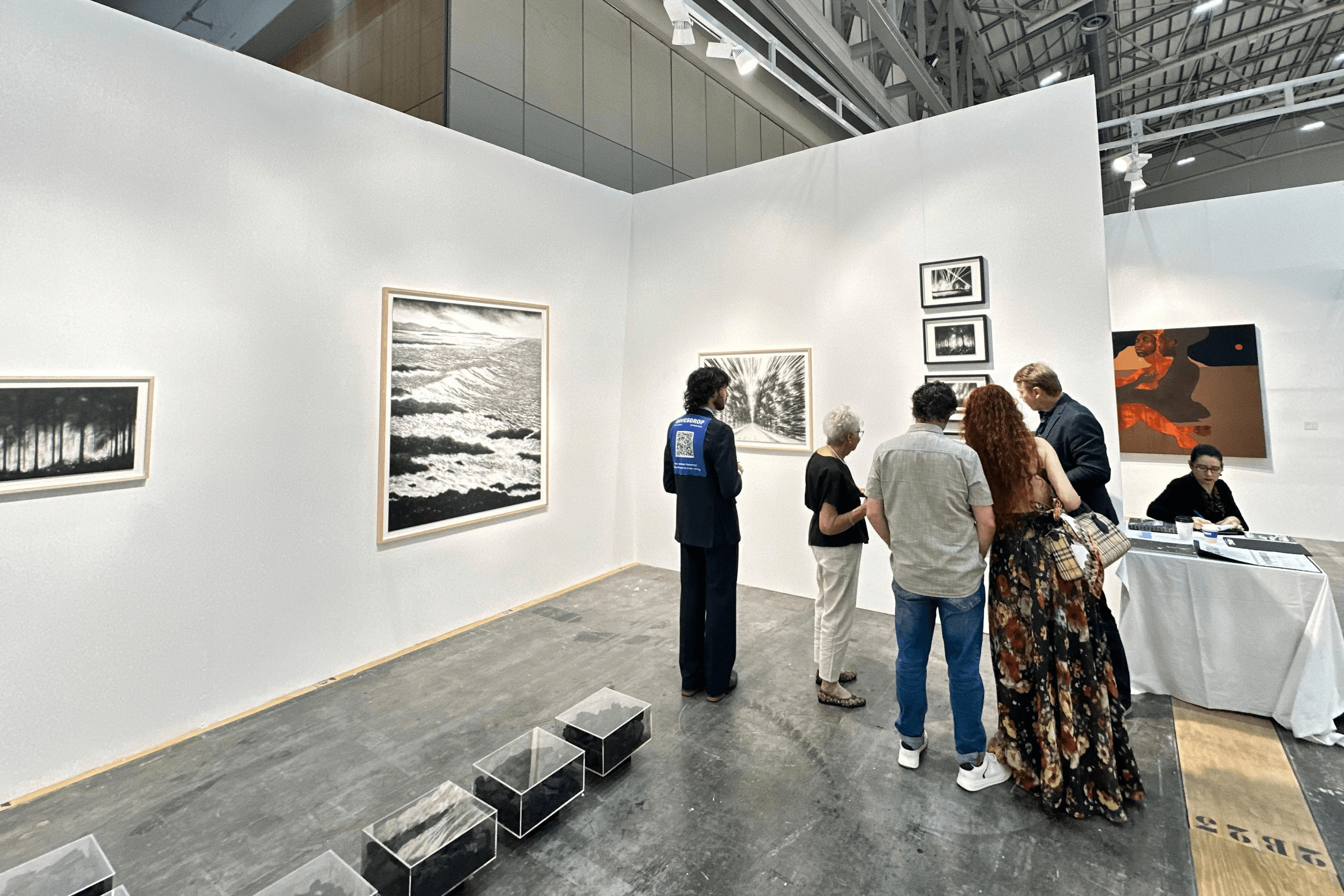
Kahlil encounters a group interaction with an artwork by Raquel Maulwurf.
Courtesy of Lux + Kahlil.
A performance like this, with so many inputs, people and movement, naturally ensures plenty of learning and adapting for the performers. The process was less about acting and more about receiving or drawing from what was available in their surroundings. Too, Lux and Kahlil didn’t necessarily experience their performance in the same way. While it may be one performance, it was conducted by two different performers. A large finding for the two was that each person has a unique way of listening. Below are some examples of the many overheard conversations that Lux + Kahlil ultimately posted on Everard Read’s Instagram.
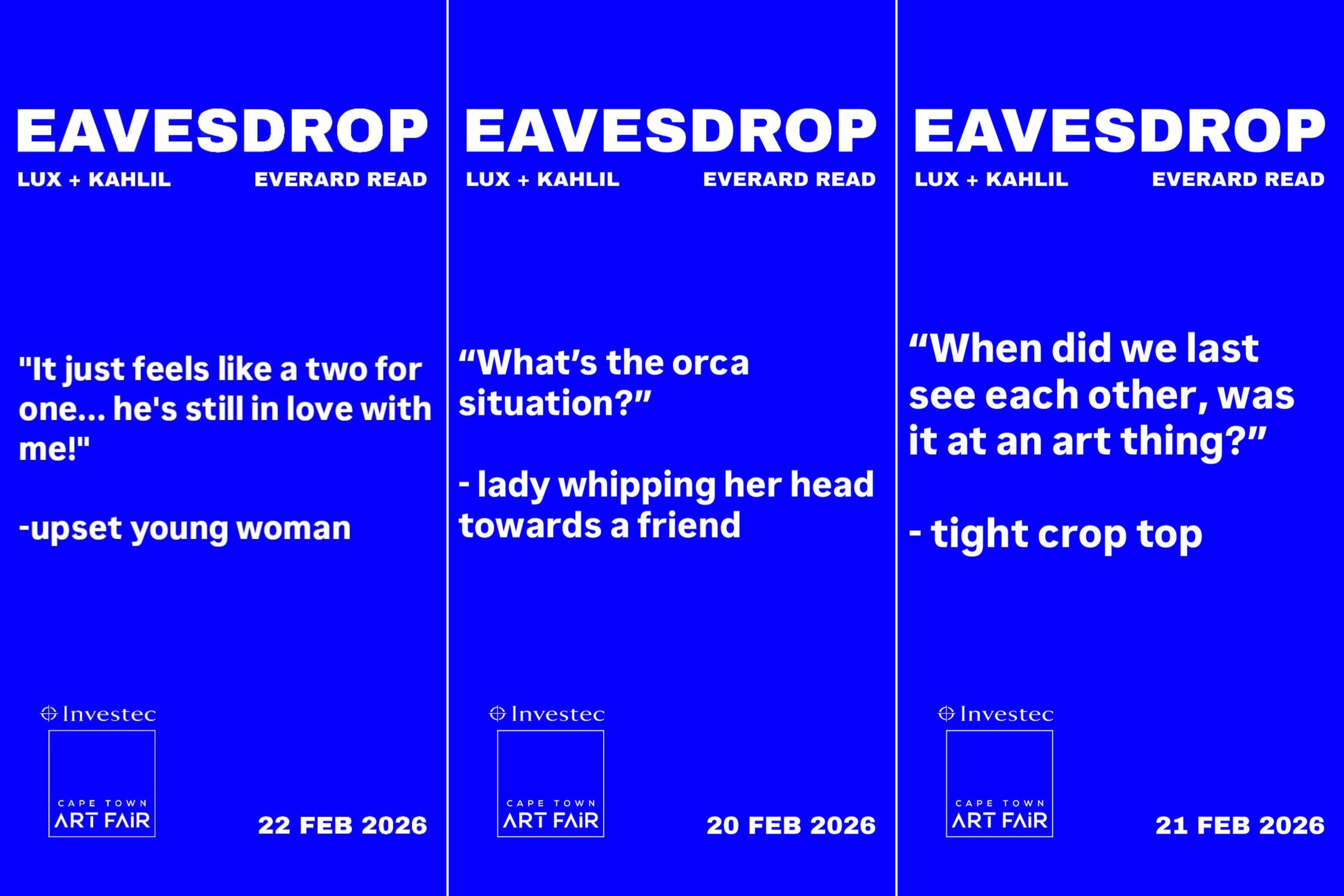
These were some of the eavesdropped moments captured and posted by the performers, originally posted on Everard Read’s Instagram.
Courtesy of Lux + Kahlil.
Lux generally found smaller, broken portions of sentences. Her experience was very much aligned with the etymology of the word ‘eavesdrop’, which derives from an eavesdrop of a house, which catches the rain falling off of a roof, to bring it into the ground. “I felt like I was the ground, and the water dropped onto me… the patter of the droplets would make an imprint. It’s about receiving. It’s a very visual word, eavesdrop.” There was a type of reshaping or sculpting of her, informed by the sounds and words which surrounded her. In this way, she followed the sound and released a need to hunt further for a finished sentence in favour of a more passive process of receiving.
For Kahlil, they felt their process was slightly more invasive. “For me… I had to come to terms with the invasiveness of the performance. I was hunting like an eagle, circling around the art fair’s territory, marking it through invasion. Meditating with the sounds that inhabited the space steered me on an easier prowl. I’d find a group, and wait. Or bump into blurbs while waving my way through the crowd...”. Kahlil generally ended their shift with fuller, meatier sentences. They found it challenging to be exposed to a level of criticism, observation, and potentially judgment as well. To know where to walk, and to remain conscious of the filtering that naturally takes place by virtue of being a person with both hearing and subjective abilities. The intention, after all, was to take what was heard as exactly what it was, and to remain as neutral as possible while doing this. Provocative, but not damning: the overheard snippets were posted anonymously, maintaining an almost archetypal quality. Interestingly, certain viewers responded to the online posts with slight uncertainty: had they said that? It might have been them. Some statements had a universal quality to them. The words that were said, often not too consciously, created an “assumed recognition of whatever it was being picked up”, as Lux put it.
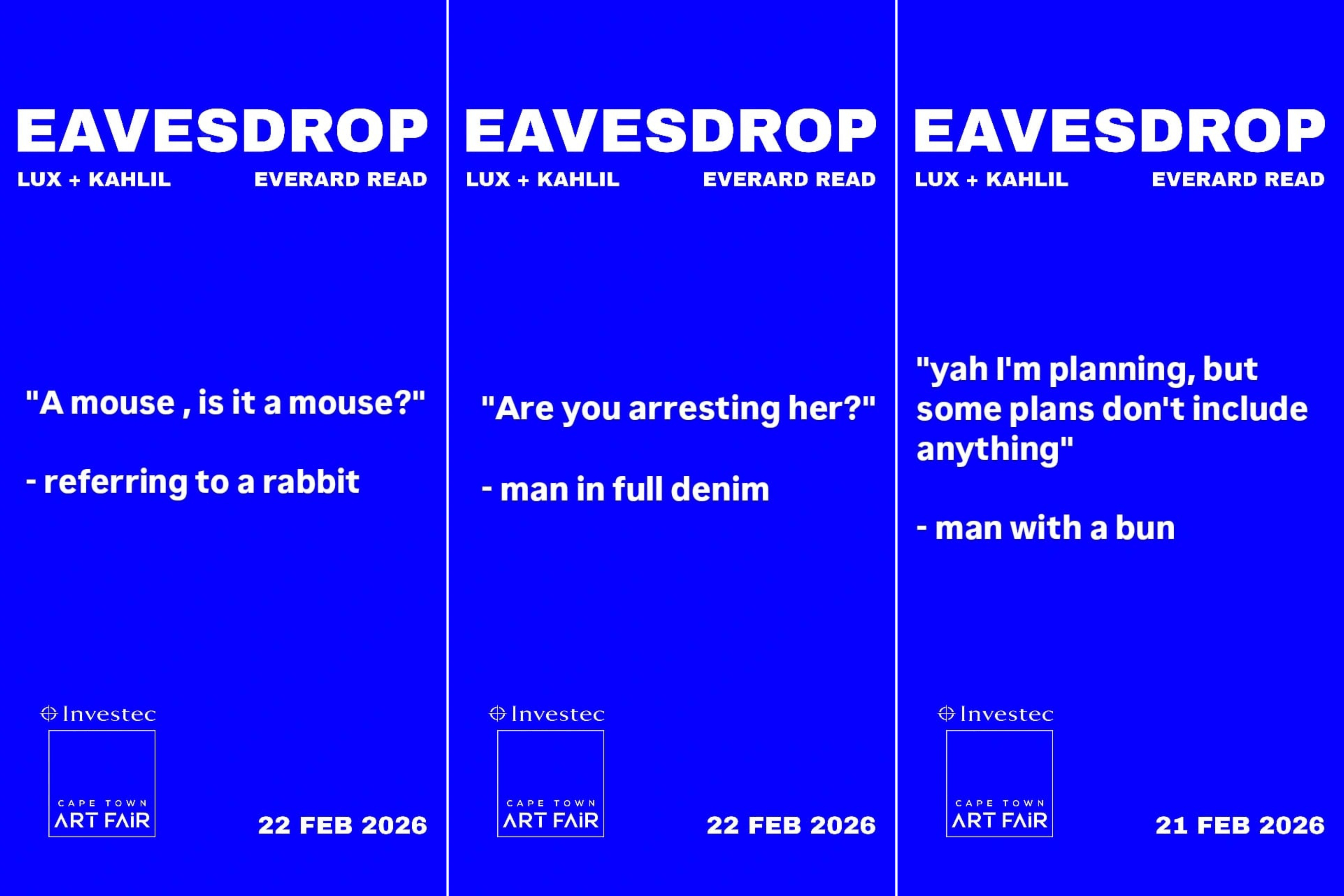
Including moments of engagement with art, or more casual gossip, Lux + Kahlil posted a range of snippets by anonymous visitors. Images originally posted on Everard Read’s Instagram.
Courtesy of Lux + Kahlil.
EAVESDROP also informed a specific way for Lux + Kahlil to experience the fair itself. Sometimes, walking past the same artwork multiple times in a day, Lux experienced the fair like a layered palimpsest: each time, she had different interactions with the artworks, with new perspectives or interpretations as she passed. Layering is an important notion that came up in discussion with the two performers, particularly when considering how the performance experimented with the complex processes of human communication. In a way, it echoed how we communicate, with a constant process of feedback, response and adjustment being central to each conversation we encounter each day. By adjusting the performance as it went on to address what would work best in the fair space, EAVESDROP echoed how communication constantly calls for response, observation, and interpretation.
“We liked that it was so simple.” Listening is such an innately human process, while simultaneously tapping into a variety of complex ideas. EAVESDROP experimented with the boundaries of listening, audience involvement, and how the body can process information. As the 13th edition’s theme, Listen, explored, a seemingly simple act is a catalyst for critical conversations that resonate widely across the contemporary art world.
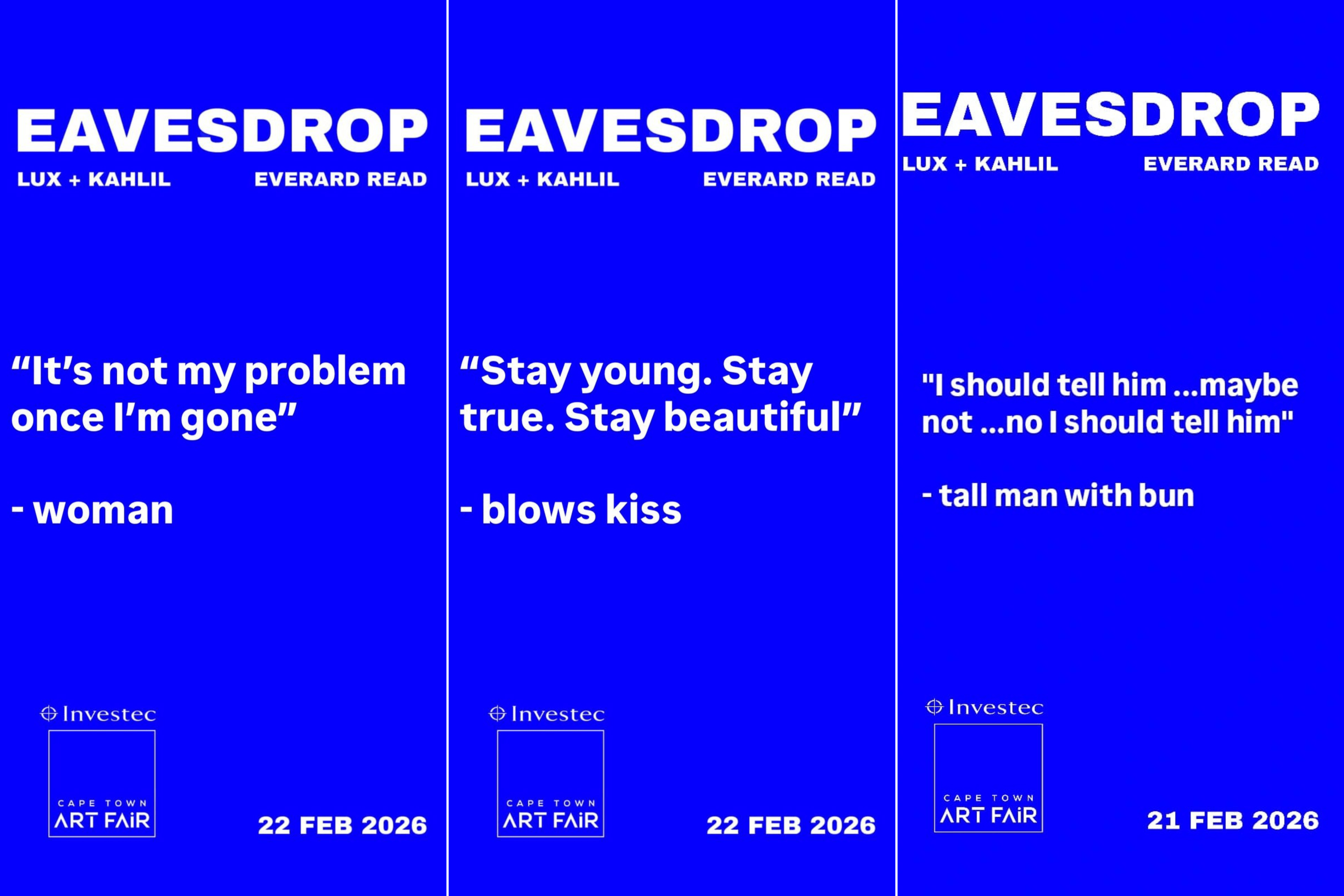
Images originally posted on Everard Read’s Instagram page.
Courtesy of Lux + Kahlil.