Nostalgic Dreamscapes: Reimagining Identity, Memory, and Queer Fantasy in the Art of Justin Yoon (Jonathan Carver Moore)
Interviewed by Milla Peerutin
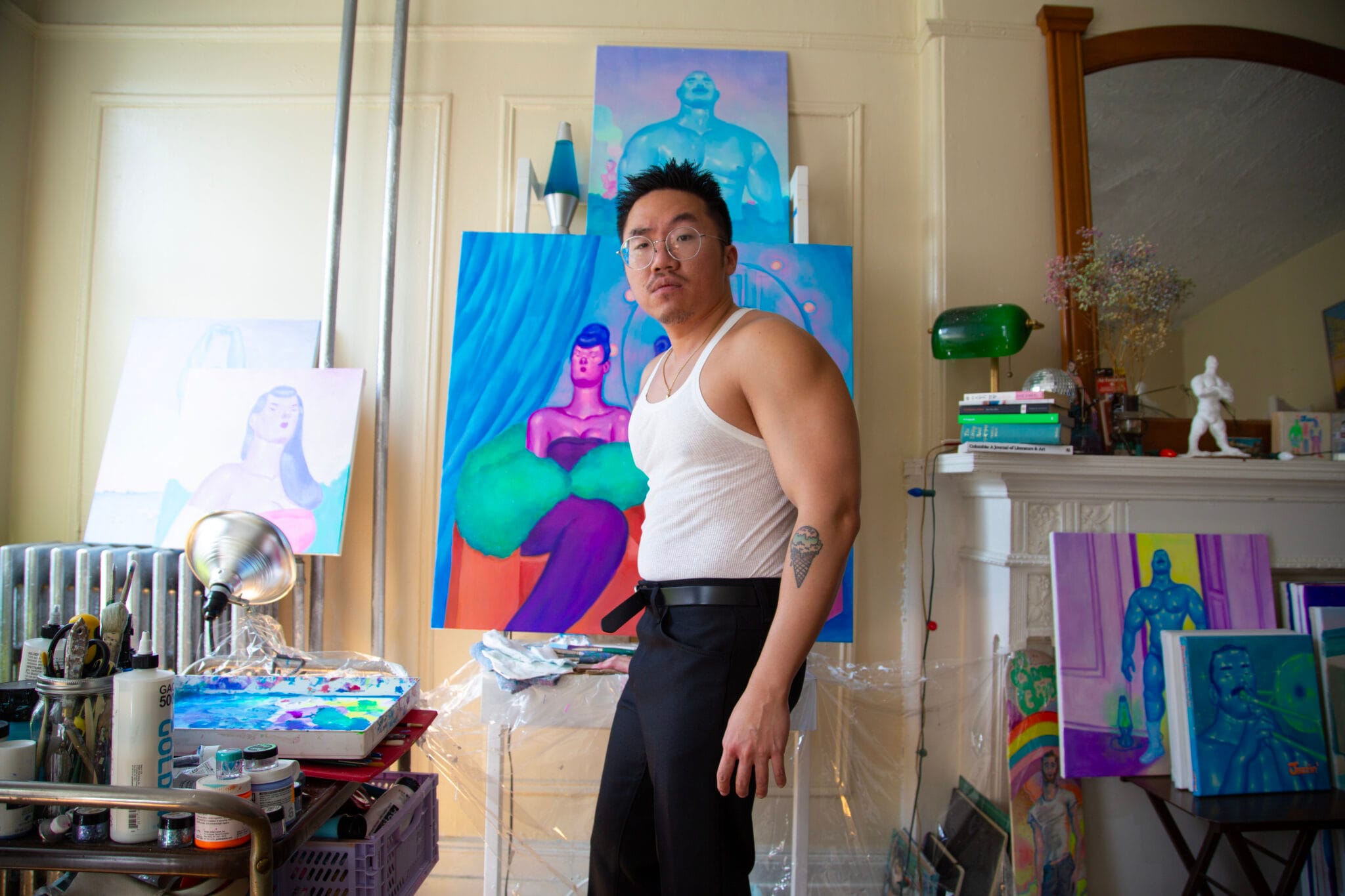
Blurring the lines between memory, fantasy, and identity, Justin Yoon creates evocative dreamscapes that reimagine queer existence through a lens of nostalgia, glamour, and cinematic opulence. Drawing from a childhood split between Los Angeles and South Korea, his work embodies a longing for places both real and imagined—iconic time periods, Hollywood’s golden age, and personal histories reshaped through the act of storytelling. Infused with theatricality and an ironic sense of melancholy, his characters navigate a world of high school reunions, glamorous parties, and endless performances, reflecting the universal queer experience of seeking belonging. In this interview, he delves into the inspirations behind his work, the process of shaping his own artistic universe, and how his practice aligns with the curatorial vision of PLAYSCAPES: Shaping Worlds and Selves at Investec Cape Town Art Fair 2025.
1. Your practice is heavily influenced by your upbringing in both LA and South Korea as a gay man. How do these diverse cultural experiences manifest in your artistic style and subject matter?
After I moved to Bundang, South Korea from LA when I was a kid, I clinged on to what LA was in my memory almost as if it was a "lost home". The palm trees, the perpetually warm dry weather, the Galleria mall in Glendale, American TV shows and advertisements, all became a hazy yet dreamy distant memory where I yearned to go back to. Over the years growing up in South Korea, I carried on with my idealized nostalgia towards things I can't physically revisit, even expanding it to things such as old time periods I didn't even exist in, or places I wanted to be, such as 1970s and 1990s New York, 1950s and 1960s California, a liberated gay place. Through American media such as TV sitcoms on cable, late night hollywood movies that would air on tv, my dad's Jazz cds, The Sims which I obsessively played, all became an escapist dreamscape I clinged on to live these fantasies, while coming of age in South Korea. After I finally moved to New York in 2010, I realized that I even started to create a yearning for my memory of South Korea, which now felt like a "lost home" to me. All of this culminated in me trying to capture and mix that specific feeling of romanticized nostalgia towards a time in life, or for a time that is long gone. I think all of this obsession with media, memory, and culture is not only a mixed cultural experience but also a very universal queer becoming, as we tend to hold on to things such as musicians, iconic actresses, old movies, a certain time period, in search of belonging- I felt like an outsider my whole life and these things ground me to this day, as a gay person, as a Korean American, and as an artist. I create things that I can hold on to, a place I can always go to for such a need for feeling, hoping to capture that moment.
2. What does the process of creation look like to you? What inspires you to make and how do you choose what to put on the canvas?
A lot of things inspire me. It could be someone I know or talked to, a movie I watched, sky color I see, a cute dog walking in the street, music I listen to, memories of someone or a place, illustrations I love, or a book I read. I am very inspired by narratives and stories, and usually there is a certain image I want to capture from all these things culminating in my head. When it comes to me, I try to grasp that moment of feeling in time.
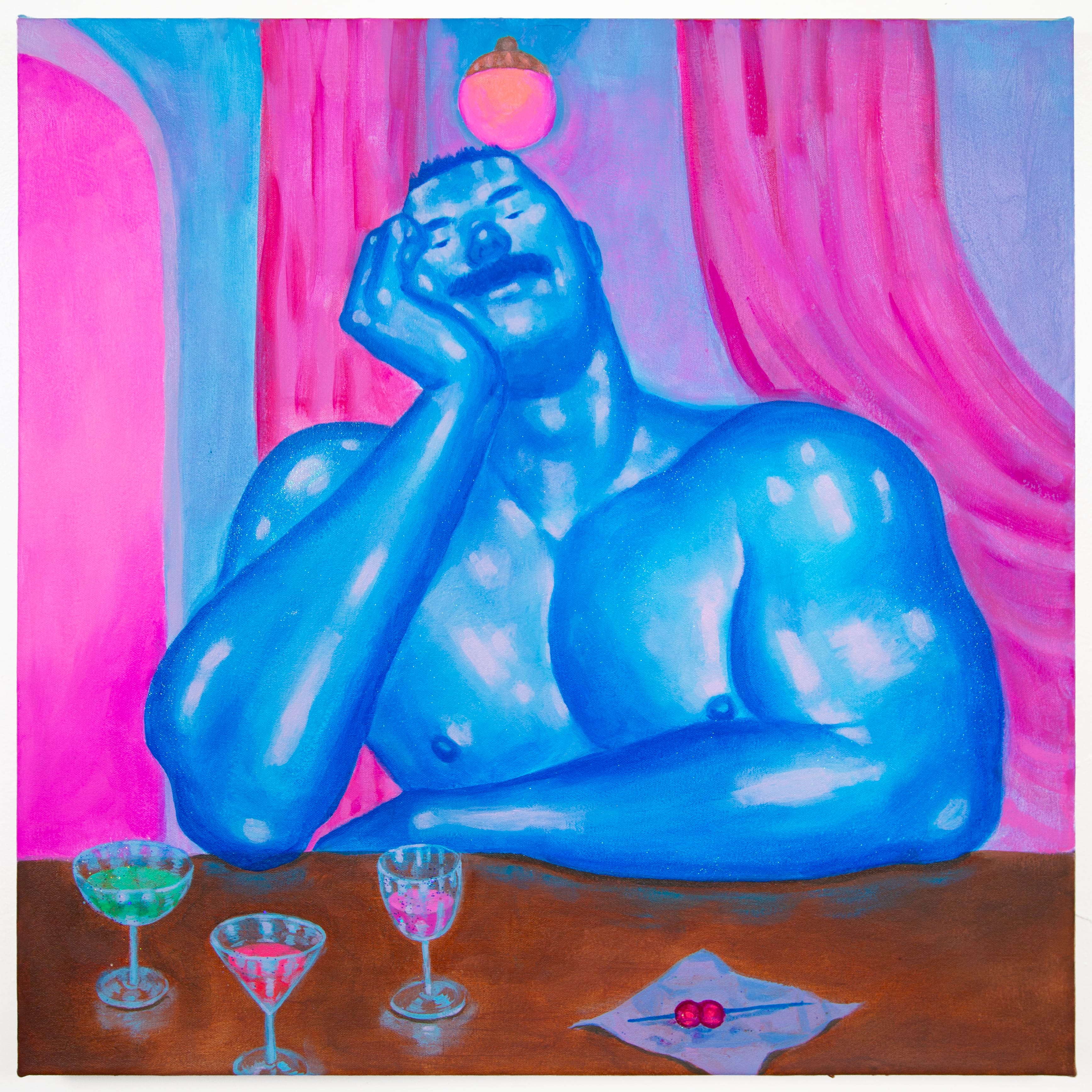
3. Your work stands out as an ode to 1930s Hollywood, intertwined with elements of nostalgia for a time of glamour and mystique, where queer identities are reimagined through a lens of opulence, longing, and cinematic fantasy. Who are the characters in your paintings and what are the stories behind them?
I created Blue Dream, Marge The Space Queen (Short for Marge), Fivepoundz (The Shih tzu), Machoman Park, and this time a new character Phoebe, as a representation of myself, my friends, my family, people I knew in my life, characters I consumed in stories, all things queer, emotions I felt in life. They are myself and everyone else, and even the viewers- I want the viewers to feel the way I feel when I read or watch stories, as they themselves become a part of myself. The continuing simple story behind them in my work is that they are a group of old friends going through a never ending high school reunion.
In this series, I was very inspired by 1930s Screwball Comedies, and Mae West movies- I felt a weird ironic feeling watching them, as these movies drenched with glamour and comedy were a reflection of its contrasting dark time period, and I couldn't help but feel a tinge of satirical melancholy created by the similarity of the current time we live in. I wanted to portray that feeling I had with these characters by showing their usual episodes in disconnected glamorous rooms where they can't escape for the time being- specifically in this series, for a single night at a party. They are interacting less with each other, and all in a state of reminiscence, disengaged from the loud glamorous surroundings. However, the party is eventually going to end and they will move on to another day.
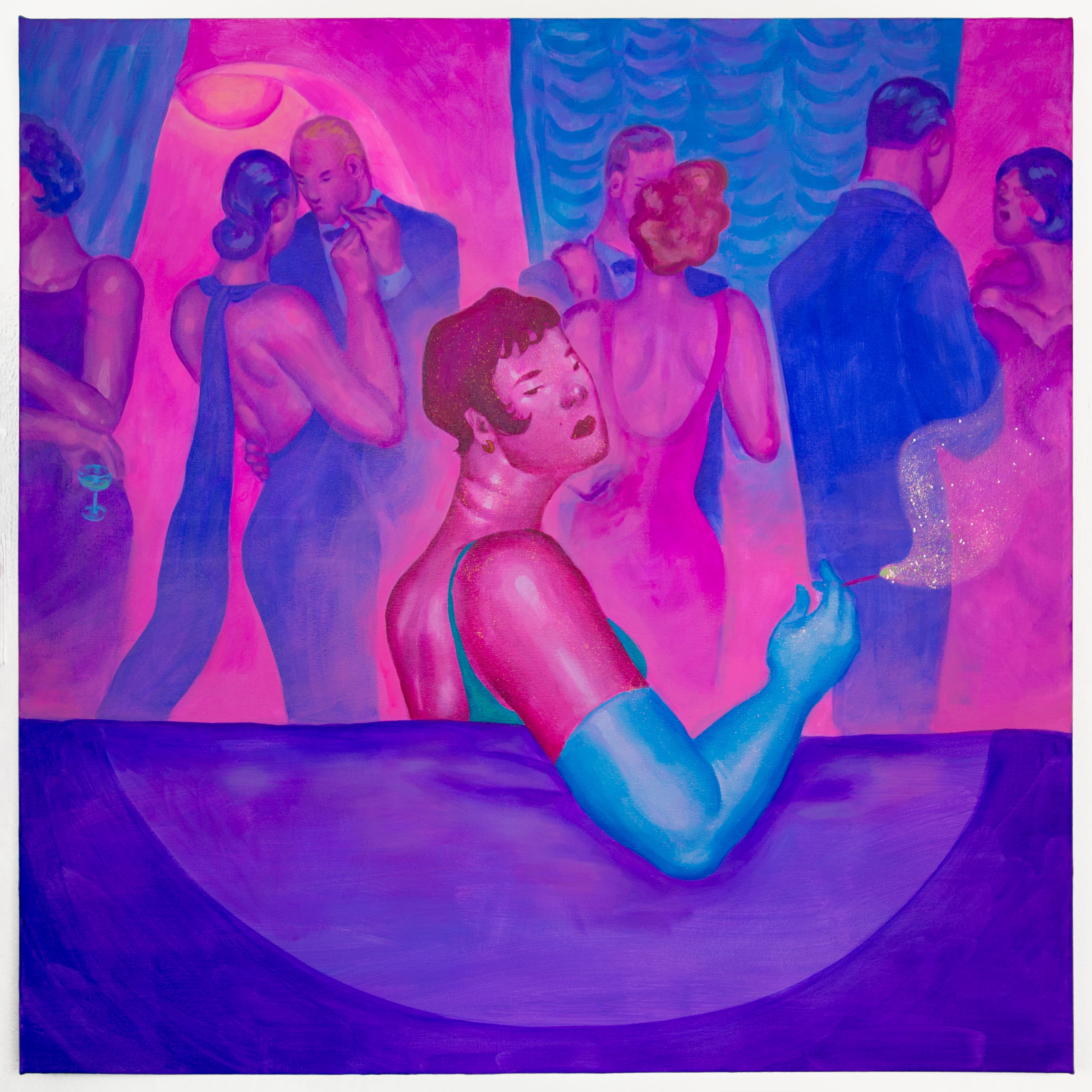
4. Your work challenges the way masculinity and femininity are traditionally perceived. How has your own understanding of gender fluidity shaped your artistic approach?
I strongly believe masculinity and femininity coexist in everyone, and it is a way of how we choose to perform our daily lives in drag. Hyper masculine and Hyper feminine images are powerful to me to portray to play up this idea; The cheeky gay dress up of these asian queer characters are both ironically and unironically showboating their sensuality and sexuality, not tied to sex -- Almost as if there is nothing out of the ordinary when they are a muscle clad sweaty gogo dancer, or a perpetually dressed up glamorous starlet going through daily lives. The original trio, Marge, Blue dream, and Fivepoundz, were always depicted this way from the beginning to exaggerate this sensuality and identity we have in ourselves and cultivate. Especially as Queer Asian characters, that was very important for me to capture.
5. What advice would you offer to emerging artists who are navigating their identities and aiming to incorporate personal and cultural narratives into their work?
The only thing I can say is just portray what you love to portray. Look into what you gravitate to or obsess over, regardless of any rational reasoning, and just capture it. There will be your personal and cultural narrative in it without even trying, as we are the sum of all the moments of our lives.
6. The theme for the curated sections of Investec Cape Town Art Fair is PLAY and SOLO curator, Céline Seror has chosen to title her section PLAYSCAPES: Shaping Worlds and Selves. How do you find your practice fits into her curatorial vision and what has inspired the body of work that will be shown at Investec Cape Town Art Fair 2025?
My work is quite literally a practice of shaping my own world and selves into a narrative dreamscape- I often think of my characters as a part of an ongoing series with no end, with episodes continuing endlessly. This series of work is called "A Chamber Piece", as I felt like I was putting a chamber play due to the limited space they inhabit in this story, and that notion of it being a literal play played by my characters made me look at the whole thing differently. Their stories will continue, and maybe there will be another play in the future soon.